What is Quantity Demanded in Microeconomics?
Explore the concept of quantity demanded in microeconomics, its determinants, and how it affects market behavior and consumer choices.
Introduction to Quantity Demanded
Understanding quantity demanded is essential for grasping how markets work. It tells us how much of a product consumers want to buy at a specific price.
In microeconomics, this concept helps explain consumer behavior and how prices influence purchasing decisions.
Defining Quantity Demanded
Quantity demanded refers to the exact amount of a good or service that buyers are willing and able to purchase at a particular price during a given period.
It differs from demand, which represents the entire relationship between price and quantity demanded across all prices.
Quantity demanded is a single point on the demand curve.
It changes when the price of the good changes.
Other factors remaining constant, a lower price usually increases quantity demanded.
Law of Demand and Quantity Demanded
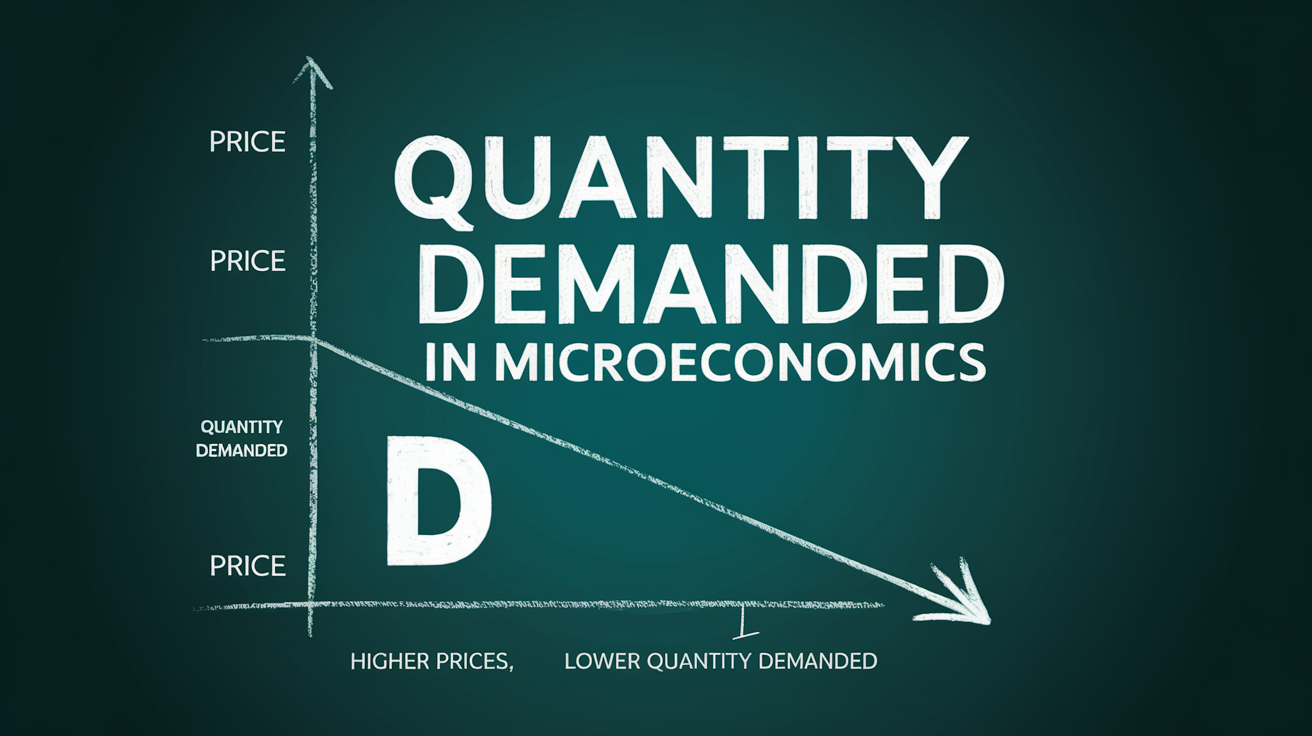
The law of demand states that, all else equal, quantity demanded moves inversely with price.
This means when prices fall, consumers buy more, and when prices rise, they buy less.
This inverse relationship shapes the downward slope of the demand curve.
Quantity demanded changes only when price changes, not when other factors shift.
Determinants Affecting Quantity Demanded
While quantity demanded changes with price, several other factors influence overall demand but do not directly change quantity demanded at a given price.
- Price of the good:
The primary factor affecting quantity demanded.
- Consumer income:
Changes shift demand, not quantity demanded at a fixed price.
- Prices of related goods:
Substitutes and complements affect demand curves.
- Tastes and preferences:
Can shift demand but not quantity demanded at a specific price.
- Expectations:
Future price or income expectations influence demand shifts.
Difference Between Quantity Demanded and Demand
It's important to distinguish quantity demanded from demand to avoid confusion.
- Quantity demanded:
The amount consumers buy at a specific price.
- Demand:
The entire schedule or curve showing quantities consumers will buy at all prices.
Changes in price cause movement along the demand curve (quantity demanded changes).
Changes in other factors cause the demand curve to shift (demand changes).
How Quantity Demanded Impacts Market Equilibrium
Quantity demanded plays a key role in determining market prices and quantities sold.
If quantity demanded exceeds quantity supplied, prices tend to rise.
If quantity demanded is less than quantity supplied, prices tend to fall.
Equilibrium occurs where quantity demanded equals quantity supplied.
Examples Illustrating Quantity Demanded
Consider a cup of coffee priced at $3. If the price drops to $2, more people may buy coffee, increasing quantity demanded.
Conversely, if the price rises to $4, fewer people will buy it, reducing quantity demanded.
Conclusion
Quantity demanded is a fundamental microeconomic concept that explains how consumers respond to price changes.
Recognizing the difference between quantity demanded and demand helps you better understand market dynamics and consumer choices.
What is the difference between quantity demanded and demand?
Quantity demanded is the amount bought at a specific price, while demand is the whole relationship between price and quantity across all prices.
What causes quantity demanded to change?
Quantity demanded changes only when the price of the good changes, assuming other factors remain constant.
How does consumer income affect quantity demanded?
Consumer income affects overall demand but does not change quantity demanded at a fixed price.
Why does the demand curve slope downward?
Because of the law of demand, quantity demanded increases as price decreases, creating a downward sloping demand curve.
What happens when quantity demanded exceeds quantity supplied?
Prices tend to rise to restore equilibrium, balancing quantity demanded and supplied.