What is Marginal Rate Of Substitution?
Understand the Marginal Rate of Substitution, its role in consumer choice, and how it helps analyze preferences in economics.
Introduction to Marginal Rate of Substitution
When making choices, you often weigh how much of one thing you're willing to give up for another. This idea is captured by the Marginal Rate of Substitution (MRS). It helps explain how consumers decide between different goods based on their preferences.
In this article, we'll break down what MRS means, why it matters, and how it shapes economic decisions. You'll learn how this concept simplifies understanding trade-offs in everyday life.
What is Marginal Rate of Substitution?
The Marginal Rate of Substitution is the rate at which a consumer is willing to exchange one good for another while keeping their overall satisfaction constant. In simpler terms, it shows how much of one product you’d give up to get a little more of another without feeling better or worse.
MRS is important in economics because it measures preferences and helps explain consumer behavior. It’s usually expressed as the slope of an indifference curve, which represents combinations of goods that provide equal satisfaction.
How Does Marginal Rate of Substitution Work?
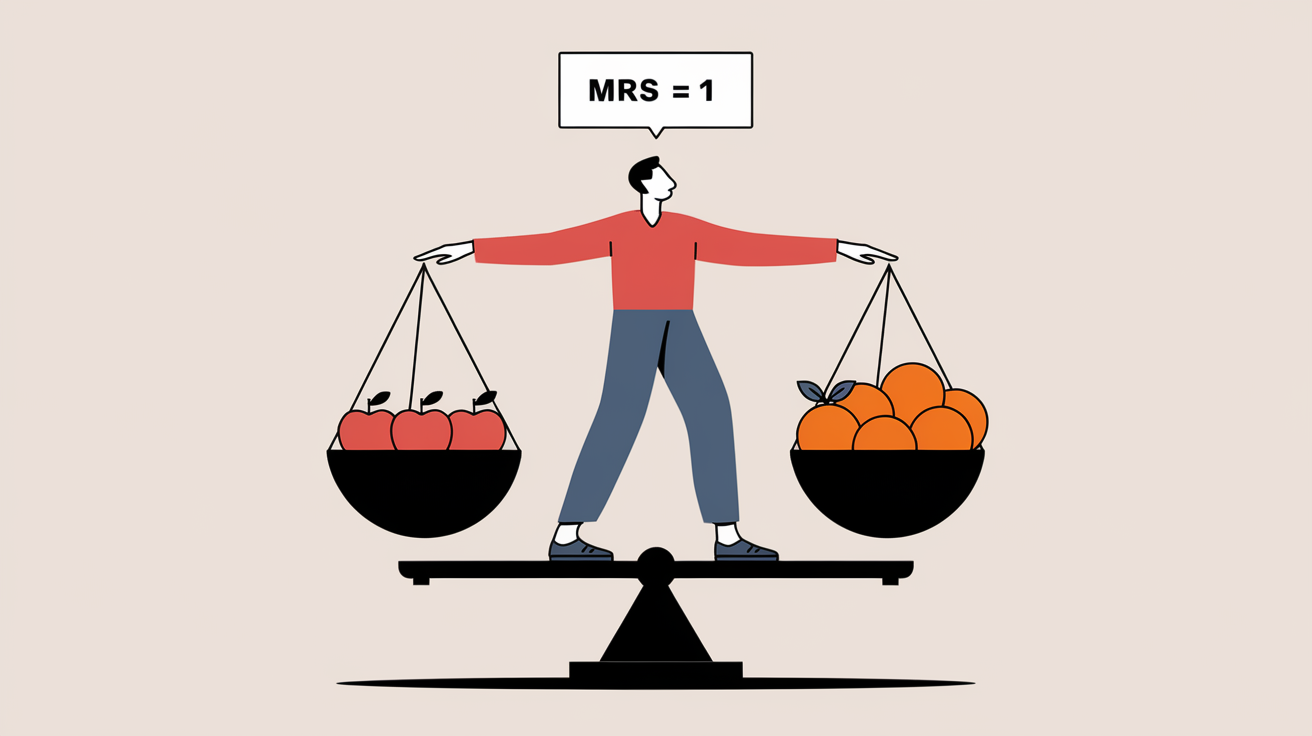
Imagine you have two goods: apples and oranges. If you’re willing to give up 2 apples to get 1 more orange without changing your happiness, your MRS of apples for oranges is 2. This means you value 1 orange as much as 2 apples.
As you consume more oranges and fewer apples, your willingness to trade apples for oranges changes. Typically, the MRS decreases because each additional orange is less valuable compared to apples you give up.
MRS reflects consumer preferences and willingness to trade.
It decreases as you consume more of one good, showing diminishing marginal utility.
Helps in understanding demand and optimal consumption choices.
Marginal Rate of Substitution and Indifference Curves
Indifference curves graphically show combinations of two goods that give the same satisfaction. The MRS is the slope of this curve at any point. A steeper slope means you need to give up more of one good to get an extra unit of the other.
Since MRS changes along the curve, it reflects how your preferences shift depending on what you already have. This helps economists predict how consumers adjust their choices when prices or incomes change.
Indifference curves are downward sloping, showing trade-offs.
MRS equals the absolute value of the slope of the indifference curve.
Helps determine the consumer’s equilibrium point when combined with budget constraints.
Why is Marginal Rate of Substitution Important?
MRS plays a key role in consumer theory and market analysis. It helps explain how people allocate their limited resources to maximize satisfaction. Businesses and policymakers use this concept to predict demand and design better products or policies.
Understanding MRS also aids in grasping concepts like substitution effect and income effect, which describe how changes in prices influence consumer choices.
Assists in analyzing consumer preferences and demand patterns.
Supports pricing strategies by showing how consumers switch between goods.
Helps in welfare economics to assess changes in consumer well-being.
Calculating Marginal Rate of Substitution
Mathematically, MRS is the ratio of the marginal utilities of two goods. Marginal utility measures the added satisfaction from consuming one more unit of a good.
The formula is:
- MRS = MU of Good A / MU of Good B
For example, if the marginal utility of apples is 10 and oranges is 5, the MRS of apples for oranges is 10/5 = 2. This means you’d trade 2 apples for 1 orange to stay equally satisfied.
Limitations of Marginal Rate of Substitution
While MRS is a powerful tool, it has some limitations. It assumes consumers have clear preferences and can always trade goods smoothly, which may not hold true in real life.
Also, MRS is based on the idea of continuous goods and may not apply well to indivisible items or goods with fixed quantities.
Assumes rational behavior and consistent preferences.
May not reflect real-world constraints like budget limits or availability.
Less applicable for goods that cannot be divided or substituted easily.
Conclusion
The Marginal Rate of Substitution is a fundamental concept that helps us understand how consumers make choices between different goods. It shows the trade-offs people are willing to make to maintain satisfaction.
By learning about MRS, you gain insight into consumer behavior, market demand, and economic decision-making. This knowledge can help you better analyze financial decisions and market trends.
FAQs
What does Marginal Rate of Substitution measure?
It measures how much of one good a consumer is willing to give up to gain an additional unit of another good while keeping satisfaction unchanged.
How is MRS related to indifference curves?
MRS is the slope of an indifference curve, showing the rate at which a consumer trades one good for another without changing their overall happiness.
Why does MRS usually decrease as you consume more of one good?
Because of diminishing marginal utility, each additional unit of a good provides less extra satisfaction, so you're willing to give up fewer units of the other good.
Can MRS be used for all types of goods?
MRS works best for divisible goods with clear preferences but is less effective for indivisible or unique goods that cannot be easily substituted.
How does MRS help businesses?
Businesses use MRS to understand consumer preferences and how customers might switch between products, aiding in pricing and marketing strategies.