What is Mathematical Economics?
Explore Mathematical Economics, its role in modeling economic theories, and how it helps in decision-making and policy analysis.
Introduction to Mathematical Economics
Mathematical economics is a branch of economics that uses mathematical methods to represent economic theories and analyze problems. It helps you understand complex economic relationships clearly and precisely.
By using formulas, graphs, and models, mathematical economics makes it easier to predict economic outcomes and make better decisions in business and policy.
Why Mathematical Economics Matters
Mathematical economics provides a structured way to study economic behavior. It helps economists and decision-makers:
Formulate clear hypotheses and test them rigorously.
Analyze the impact of changes in variables like prices, income, or interest rates.
Predict future trends and economic outcomes.
Design efficient policies and strategies based on quantitative evidence.
Key Concepts in Mathematical Economics
Several important concepts form the foundation of mathematical economics:
- Optimization:
Finding the best solution, such as maximizing profit or minimizing cost.
- Equilibrium:
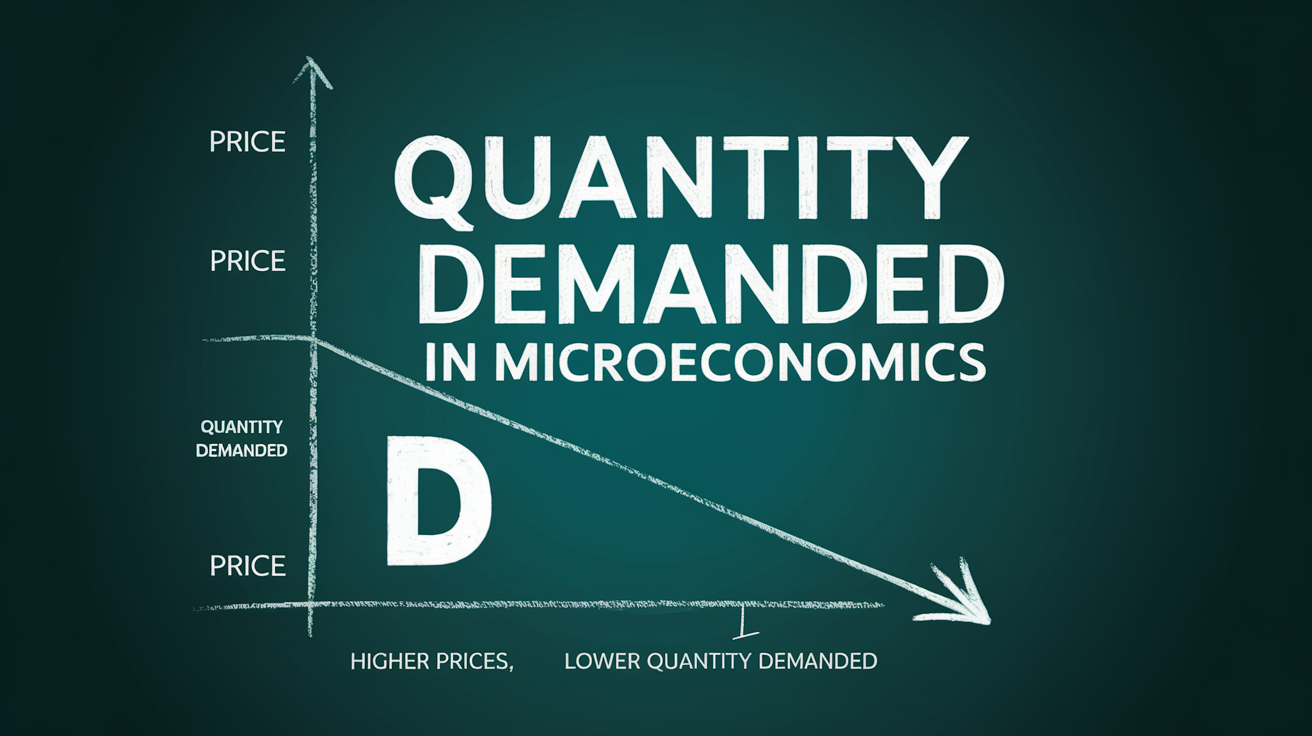
A state where economic forces balance each other, like supply equaling demand.
- Game Theory:
Analyzing strategic interactions among decision-makers.
- Comparative Statics:
Studying how changes in parameters affect economic outcomes.
Common Mathematical Tools Used
Mathematical economics relies on various tools to model economic problems effectively:
- Calculus:
Helps analyze changes and optimize functions.
- Linear Algebra:
Used for systems of equations and matrix operations.
- Probability and Statistics:
Essential for dealing with uncertainty and data analysis.
- Differential Equations:
Model dynamic economic processes over time.
Applications of Mathematical Economics
Mathematical economics is applied in many areas, including:
- Microeconomics:
Analyzing consumer behavior, firm production, and market structures.
- Macroeconomics:
Studying economic growth, inflation, and unemployment.
- Financial Economics:
Modeling asset prices and risk management.
- Policy Analysis:
Evaluating the effects of fiscal and monetary policies.
Benefits of Learning Mathematical Economics
Understanding mathematical economics equips you with skills to:
Interpret economic data and trends accurately.
Develop logical and quantitative reasoning.
Make informed decisions in finance, business, and government.
Communicate complex ideas clearly using models and graphs.
Challenges and Considerations
While powerful, mathematical economics has some challenges:
It requires a good grasp of mathematics, which can be a barrier for some.
Models may oversimplify real-world complexities.
Results depend heavily on assumptions, which must be realistic.
Conclusion
Mathematical economics is a vital tool that helps you understand and solve economic problems with clarity and precision. It bridges theory and real-world application by using math to explain how economies work.
By mastering mathematical economics, you can enhance your ability to analyze data, forecast trends, and make smarter financial and policy decisions.
What is the main purpose of mathematical economics?
Its main purpose is to use mathematical methods to represent economic theories clearly and analyze economic problems effectively.
Which mathematical tools are essential in mathematical economics?
Calculus, linear algebra, probability, statistics, and differential equations are commonly used tools.
How does mathematical economics help in policy-making?
It provides quantitative models to predict the effects of policies, helping design efficient and effective economic strategies.
What are some key concepts in mathematical economics?
Optimization, equilibrium, game theory, and comparative statics are fundamental concepts.
Are there any limitations to mathematical economics?
Yes, it can oversimplify reality, depends on assumptions, and requires strong math skills.